- Welcome to Asha Tea Company
- +91 9082650573
- ashateacompany01@gmail.com

It’s 11:47 p.m. The house is finally quiet. Your phone lights up with a message you haven’t even opened yet, and already your jaw is tight, your shoulders have crept up towards your ears, and your heart is beating as if you’re running late for something.
Nothing has happened. And yet, your body is ready for everything.
If that feels familiar, I want you to know something before we go any further: you are not weak, you are not dramatic, and you are not broken. Your nervous system is simply doing what it learned to do.
And here is the part that gives me so much hope: anything that was learned can, gently, be learned again.
Long before your mind has formed a single thought, your autonomic nervous system has already made a decision.
Harvard Health Publishing explains that when you sense a threat, a small almond-shaped region of the brain called the amygdala sends a distress signal to the hypothalamus, which works like a command centre. Within moments, adrenaline is released, your heart speeds up, your breathing quickens and your muscles brace.
If the feeling continues, a second system follows, keeping cortisol flowing so the body stays on alert.
This system is a gift. It was designed to save us from tigers, fires and floods, and then to switch off once the danger passed.
The trouble is that modern danger rarely passes.
It arrives as an unread email, an EMI date, a difficult family conversation, or a feed that never ends.
So the body never fully gets the message that it is safe. It stays on a low simmer, day after day.
We call it “being busy.”
Our nervous system calls it survival.
Sometimes the nervous system doesn’t speak through a racing heart. Sometimes it speaks through the skin.
Many of us have noticed this without ever naming it.
Stress-induced hives (urticaria): itchy, raised welts that appear and fade, sometimes within hours.
Neurodermatitis: an itch-scratch loop in which repeated scratching or rubbing leaves thickened, itchy patches.
Eczema flares: stress can trigger or worsen itching and inflammation in skin that is already sensitive.
Skin changes have many possible causes, so please see a dermatologist if anything is new, spreading or persistent.
I share this not to worry you, but because so many people blame themselves for symptoms that are really their body asking for rest.
The body keeps a careful record.
It is not punishing you.
It is talking to you.
Here is where the science turns tender.
Neuroscientists have shown that learning is not just an idea; it is physical. Every experience you repeat strengthens the connections, or synapses, between brain cells.
Researchers call one version of this long-term potentiation: the more often two neurons signal together, the more easily they signal again.
Stanford neurobiologist Carla Shatz captured it in a phrase that has become famous: neurons that fire together, wire together.
Think about what that means for your evenings.
Every night you scroll in panic before sleep, that pathway gets a little more practised.
And every night you choose one slow breath, one warm cup, one quiet pause, you are rehearsing something new.
You are, quite literally, teaching your brain a different memory of what night-time feels like.
A team at Massachusetts General Hospital and Harvard Medical School, led by researchers including Britta Hölzel and Sara Lazar, saw something like this on brain scans.
After an eight-week mindfulness programme, participants showed increases in grey-matter density in the hippocampus, a region central to learning, memory and emotional regulation.
In an earlier study from the same group, people who reported feeling less stressed also showed reduced grey-matter density in the amygdala, the very region that sounds the alarm.
The brain you take to bed tonight can be gentler than the one you woke up with.
In 2023, researchers at Stanford University, in a study led by Melis Yilmaz Balban with David Spiegel and Andrew Huberman, compared simple daily breathing practices with mindfulness meditation.
Over one month, more than a hundred participants practised for just five minutes a day.
The practice that stood out was the cyclic sigh: two inhales through the nose, followed by a long, slow exhale through the mouth.
Compared with mindfulness meditation, cyclic sighing led to a greater improvement in positive mood and a greater reduction in resting breathing rate, a sign that the body was shifting towards calm.
Five minutes.
No app, no equipment, no perfect setting.
Just you, and an exhale that is longer than the breath that came before it.
Fifty years ago, Harvard Medical School cardiologist Dr. Herbert Benson described what he called the relaxation response: the body’s built-in counterbalance to the stress response.
He found that it could be invited through two simple ingredients: a repeated focus — a word, a breath or a movement — and a gentle, non-judging return to that focus whenever the mind wanders.
What moves me about Dr. Benson’s work is how ordinary it is.
You don’t have to climb a mountain or go on a retreat.
A repeated, loving ritual is enough to remind the body of the way home.
Stanford researchers added one more beautiful clue in 2015.
In a study by Gregory Bratman and colleagues, people who took a 90-minute walk in nature reported less rumination, that exhausting loop of repetitive negative thought, and showed reduced activity in a brain region linked to it.
People who walked beside a busy road did not.
Slowness, greenery and quiet are not luxuries.
They are information your nervous system can read.
In the Bhagavad Gita (2.48), Krishna tells Arjuna, samatva yoga uchyate: evenness of mind is called yoga.
Not the absence of storms, but a steadiness within them. spiritual connection
And the Gita’s teaching of nishkama karma, acting without clinging to the outcome, may be the kindest way to begin.
You don’t do your evening ritual to “fix” yourself by Friday.
You do it because it is good, because you deserve it, and because each small repetition is a quiet offering to the person you are becoming.
When I left Los Angeles and came home to Mumbai to build this company, I named it Asha, the Sanskrit word for hope.
I’ll be honest with you: a cup of tea is not a cure, and I will never tell you it is.
But a cup of tea can be a cue.
A warm, familiar signal that tells your body, night after night, we are safe now; we can soften.
That is how rituals work.
That is how new wiring begins.
Put your phone in another room, or at least face down.
Dim one light.
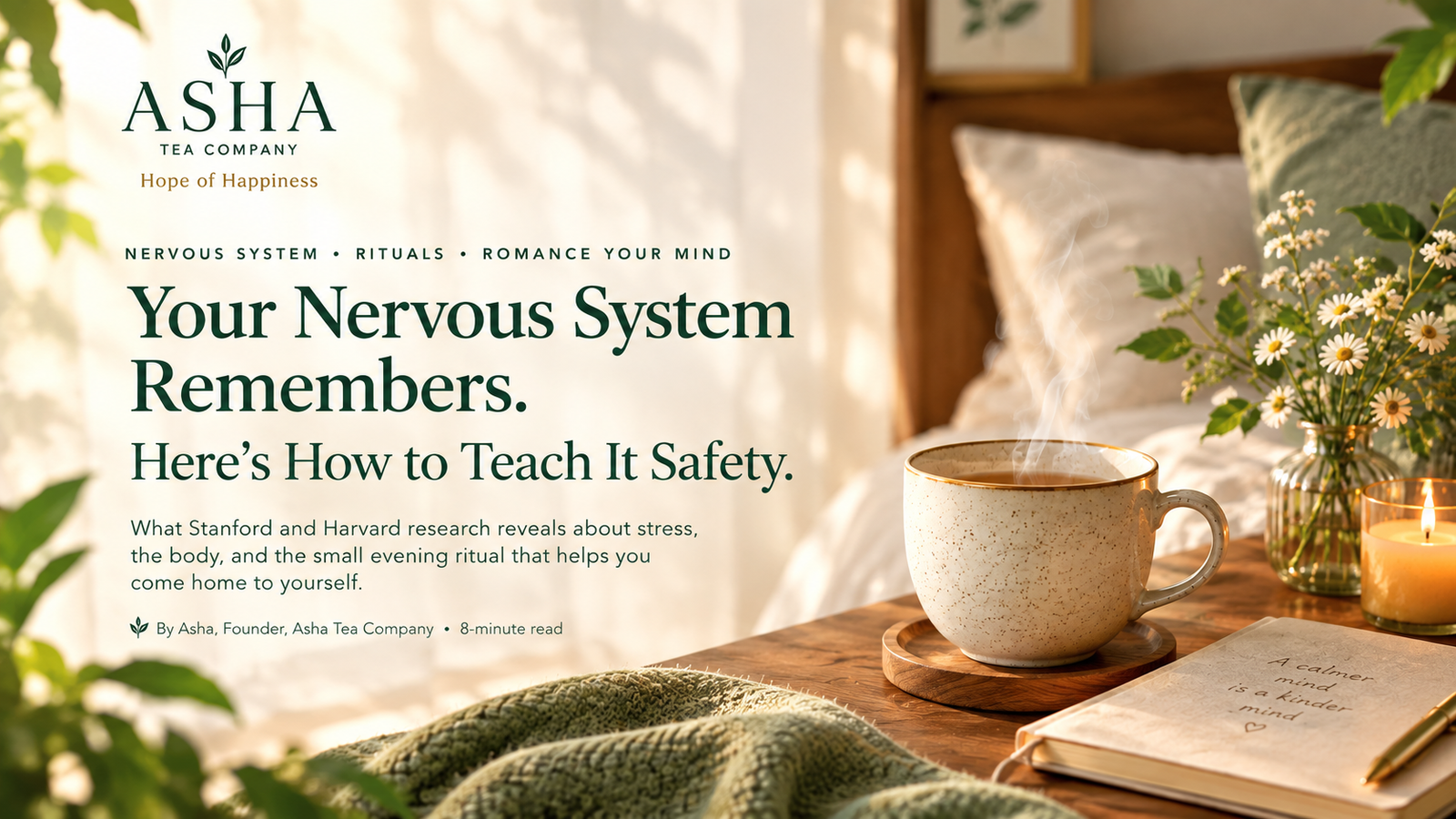
Make a caffeine-free cup, such as our Asha Calm & Sleep functional botanical herbal blend.
Watch the steam rise.
Let the kettle be the first sound of your evening.
Practise five cyclic sighs: two inhales through the nose, one long exhale through the mouth.
Wrap both hands around the cup.
Name three things your body feels right now: warmth, weight, breath.
Finish this sentence in a notebook:
“Today, my body felt safe when…”
One line is enough.
For the next 21 evenings, give your nervous system one kind memory to keep.
Brew your Exhale Cup, take five slow sighs, and write one line.
Twenty-one isn’t a magic number; it is simply long enough for a ritual to start feeling like yours.
Share your cup with #TheExhaleCup and tag @ashateacompany.
I read every one.
Your nervous system remembers everything.
So let’s give it something gentle to remember.
With hope,
Asha
Founder, Asha Tea Company
Disclaimer: This article is for general wellbeing and educational purposes only and is not medical advice. Asha Calm & Sleep is a functional botanical herbal blend and is not intended to diagnose, treat, cure or prevent any disease. If you are experiencing persistent anxiety, sleep difficulties or skin symptoms, please consult a qualified healthcare professional.