- Welcome to Asha Tea Company
- +91 9082650573
- ashateacompany01@gmail.com

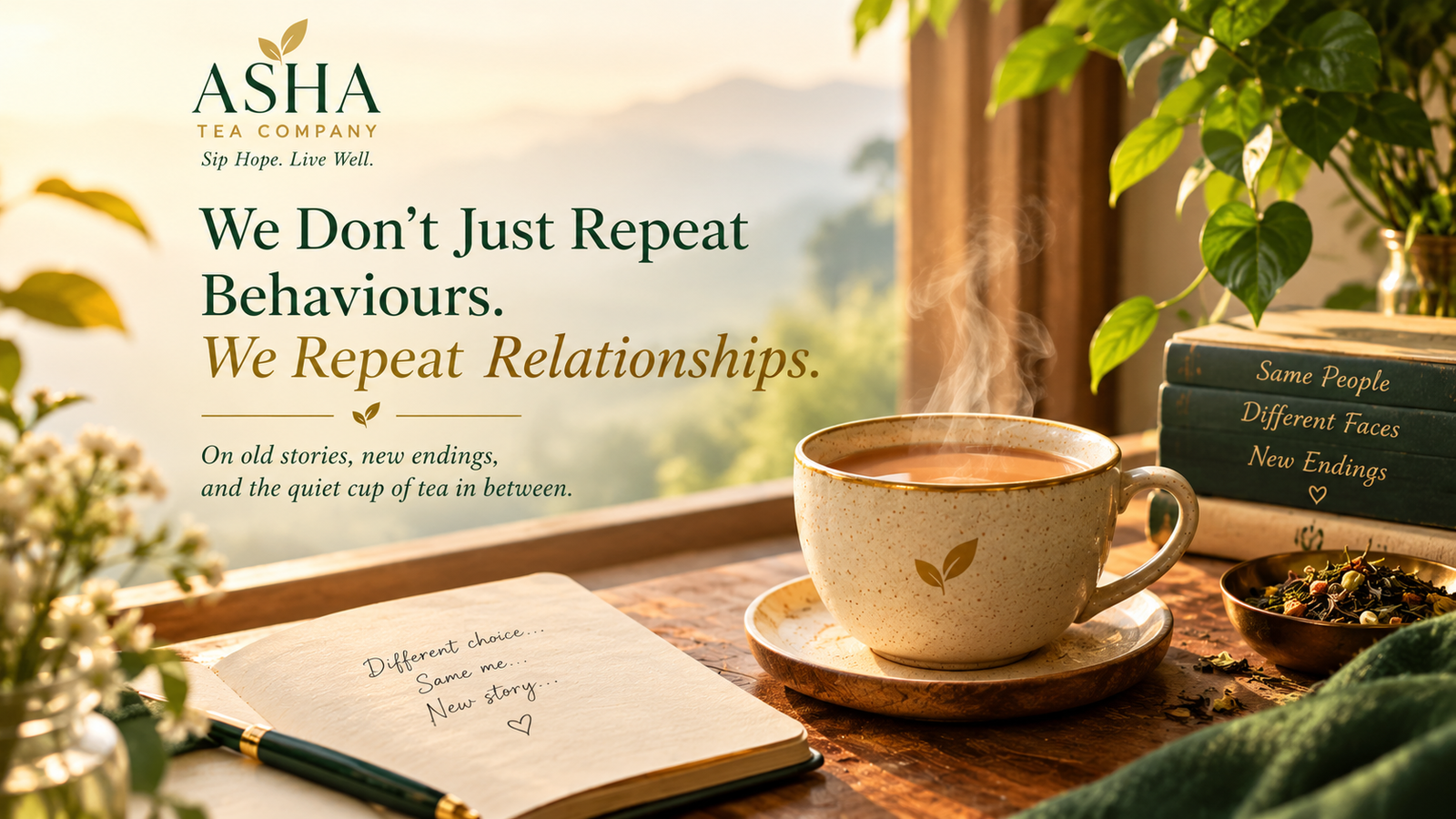
On old stories, new endings, and the quiet cup of tea in between.
I have made a lot of tea in my life.
Along the way, I have also poured out countless stories with it — some of my own, and some borrowed from every person who has ever sat across from me with a cup in their hands and something unspoken behind their eyes.
Over time, one pattern became impossible to ignore:
We don’t just repeat our habits. We repeat our relationships.
Sometimes, the same ache simply wears a different face.
At other times, the same longing to be chosen appears in a completely new room.
Even the silence we once promised ourselves we would never accept can quietly return to a new table.
For years, I believed I was simply unlucky — in love, in friendship, and in the way people treated me.
However, it took many years, and many long evenings with a cup of Kadak Chai growing cold beside my journal, to understand something the Gita had been teaching me all along:
We are not victims of other people’s choices nearly as often as we are students of our own unfinished lessons.
Krishna’s teachings to Arjuna remind us that our actions, tendencies and nature can create patterns that we continue to encounter until we become conscious of them.
In that sense, an old story may simply be looking for a new ending.
And that is not necessarily a flaw in you.
Perhaps, instead, it is your inner self doing its most patient work.
I think this is where we often misunderstand healing.
We assume that if we are still drawn to the same kind of love, the same kind of friendship, or the same kind of hurt, something must be broken within us.
But what if it isn’t damage?
What if it is an invitation to understand ourselves more deeply?
Perhaps your inner self is circling back to an old wound with the tenderness of someone who refuses to leave a story unfinished.
Therefore, the people and patterns that return to us do not always have to be seen as punishments.
They can become invitations.
Each one asks us, gently:
“Will you choose differently this time?”
That question can change everything.
After all, awareness creates a small space between what happens and how we respond.
Sometimes, that tiny space is exactly where a new story begins.
This is where I have come to believe that a cup of tea is not a small thing.
In our house, tea was never simply a beverage.
Instead, it was the pause before the reaction.
My grandmother would say, “Beta, thoda ruk” — wait a little — and hand you a cup before you were allowed to speak in anger, decide in haste, or answer a hurt with another hurt.
That pause is awareness.
More importantly, awareness can become one of the greatest freedoms we have.
We may not always be able to avoid our patterns.
However, we can learn to notice them before they finish writing themselves.
There is something powerful about sitting quietly with a warm cup in your hands.
For a few minutes, nothing needs to be solved.
You simply notice what is happening within you.
What am I feeling?
Why did that moment affect me so deeply?
Am I responding to what is happening now, or to something I have experienced before?
Sometimes, the answer arrives quietly.
At other times, it takes longer.
Either way, the pause itself matters.
This is exactly why I built Asha Tea Company the way I did.
It was never meant to be simply another wellness label.
Instead, I wanted Asha to become a small, daily invitation to stop, breathe and witness yourself.
Our tea blends are created around everyday moments — those small spaces when you can slow down, reflect and reconnect with yourself.
For example, our Calm & Sleep blend, with ingredients such as Ashwagandha and Tulsi, was created for quiet evening rituals.
Meanwhile, our Kadak Chai belongs to those mornings when you want to begin your day with warmth, presence and intention.
Because tea can be more than something we drink.
It can become a ritual.
It can become a pause.
Most importantly, it can become a moment of awareness.
Every blend we make carries this simple intention:
In the few minutes it takes to steep and sip, remember that you are the observer of your story — not merely its passenger.
If you find yourself back in a familiar ache — the same kind of distance, the same kind of longing, or the same kind of goodbye — remember that protecting your emotional health can sometimes mean choosing differently.
This is not proof that you are unlovable.
Nor is it proof that you are unlucky.
It certainly does not mean that you are destined to repeat the same story forever.
Instead, it may simply be an opportunity to notice what you could not see before.
In Vedic philosophy, the idea of samskara refers to impressions or tendencies that can influence how we perceive and respond to life.
Over time, these impressions can shape the way we approach situations, relationships and choices.
However, once we bring those patterns into awareness, we create the possibility of responding differently.
You do not need to fix yourself before you can begin changing a pattern.
You simply need to see it.
That is the power of awareness.
Once you see the old story clearly, you are no longer forced to finish it in exactly the same way.
Instead, you get to write the ending yourself.
Slowly.
Gently.
One honest choice at a time.
And perhaps, one warm cup at a time too.
So today, wherever you are, I hope you take a moment before you react.
Before you answer.
Before you walk into the next version of an old story.
Make yourself a cup of tea.
Then, sit with it.
Let the world become quiet for a moment.
Ask yourself, gently:
“What is this really about?”
You may not have the answer immediately.
And that is okay.
Sometimes, the first step is not finding the answer.
Instead, the first step is simply becoming aware of the question.
From that quiet place, you can choose differently.
Choose with awareness.
Choose with kindness.
Choose with hope.
Steep. Sit. Notice. Choose.
Take a few quiet minutes with your favorite Asha Tea.
Put the phone away.
Let go of the rush.
For a moment, simply be with yourself, your thoughts and a warm cup of tea.
Because sometimes, a new ending does not begin with a dramatic decision.
Sometimes, it begins with a pause.
Sip Hope. Live Well.
With hope and happiness,
Asha
Asha Tea Company
www.ashateacompany.com
Look for a caffeine-free herbal tea, so it fits naturally into an evening routine, made with botanicals traditionally valued in Ayurveda for calm, such as Ashwagandha and Tulsi. Asha Tea Calm & Sleep is one such blend, made to support a restful evening ritual.
A cup of tea will not remove the causes of stress. But the ritual — boiling water, steeping, sipping slowly — creates a few minutes of awareness between a feeling and a reaction. Many people find that daily pause supports a calmer state of mind.
Ashwagandha itself contains no caffeine; whether a blend is caffeine-free depends on its base. Asha Tea Calm & Sleep is a caffeine-free blend, suited to evenings.
In Vedic philosophy, samskara refers to the impressions we carry from past experiences and relationships, which quietly shape our patterns until we become aware of them.
Disclaimer: This article is for informational and educational purposes only. It does not constitute medical or professional advice. Please consult a qualified professional for personal health concerns.