- Welcome to Asha Tea Company
- +91 9082650573
- ashateacompany01@gmail.com

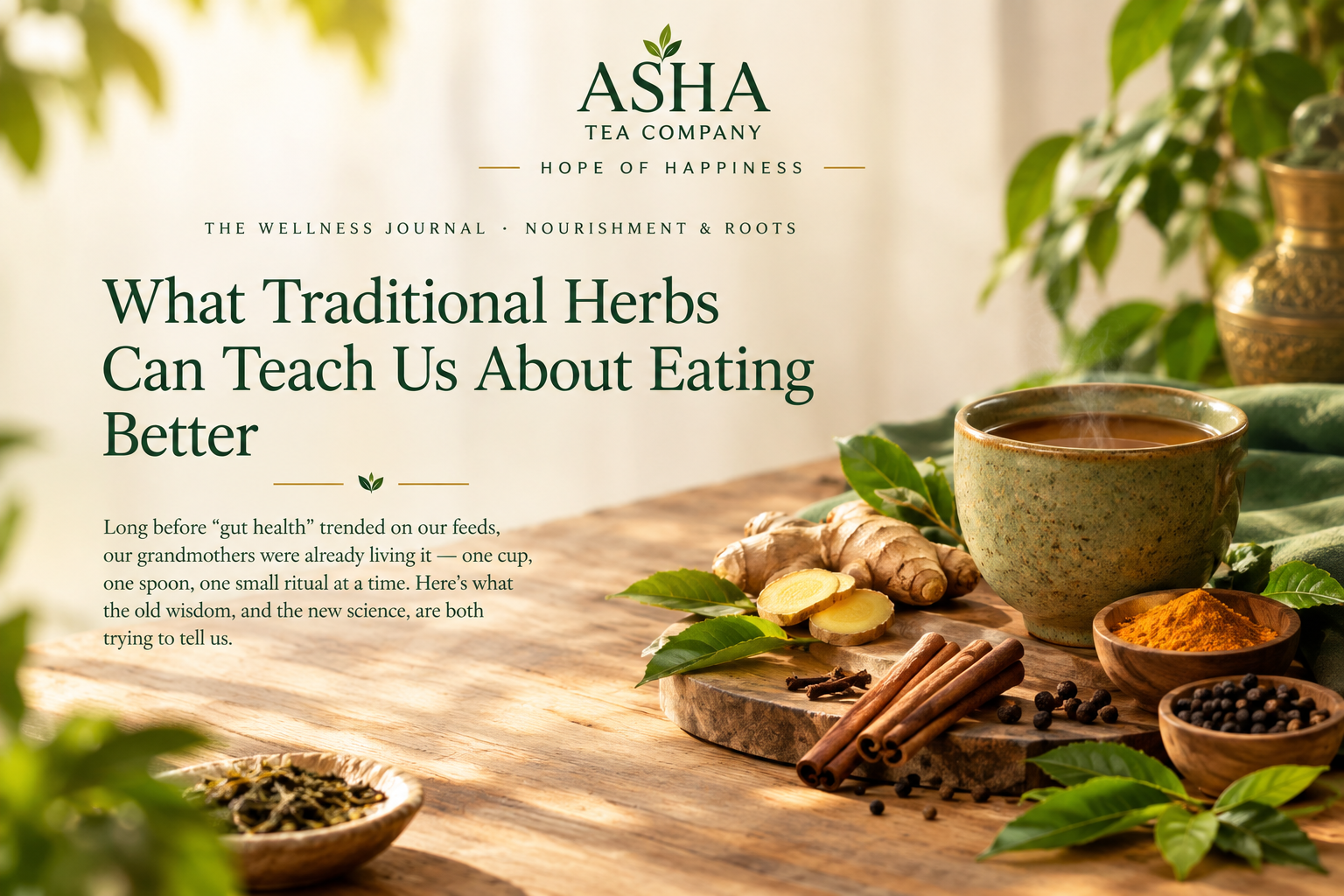
Long before “gut health” trended on our feeds, our grandmothers were already living it. They used one cup, one spoon, and one small ritual at a time. Here’s what old wisdom and new science are both trying to tell us.
I still remember the smell of my grandmother’s kitchen. At that time, I knew nothing about digestion, inflammation, or the gut microbiome. There was always a pot of something simmering. It might contain ginger, a curl of cinnamon, or a few peppercorns.
Years later, I began to understand what was happening in that kitchen. I had taken a long detour through a very different life in Los Angeles. Eventually, I returned to that familiar kitchen. What I once thought was simply flavor now felt different. I began to see food and herbs as one of the oldest wellness traditions we have.
Ayurveda, India’s ancient science of life, has a word for this: Agni, the digestive fire. The Charaka Samhita is one of Ayurveda’s foundational texts. It was composed more than two thousand years ago.
In this tradition, digestion is not treated as a background process. Instead, it is seen as a root of health. It is where nourishment can become vitality or become a burden.
Therefore, eating well was never only about what you ate. It was also about what your body could transform into strength.
That idea sounds almost obvious once you say it out loud. Yet many of us eat as if digestion will simply take care of itself. We rush through lunch. We eat cold water with hot food. Sometimes, we have dessert while standing at the counter.
However, the herbs our ancestors reached for were never an afterthought. They were part of the meal itself. They were chosen to support the traditional idea of keeping the inner fire steady.
“What you eat directly affects the structure and function of your brain and, ultimately, your mood,” notes Dr. Eva Selhub of Harvard’s Department of Psychiatry. This is another reminder that the kitchen and the mind have never really been separate rooms.
Here is the part that moves me most. Modern science is exploring many ideas that have long been part of traditional wellness practices.
For example, Harvard Health has documented herbs such as ginger, chamomile, and licorice. These herbs have a long history of traditional use. Research is also examining their potential role in digestive wellness.
Similarly, researchers at Sanford Burnham Prebys and UC San Diego studied four herbs central to Ayurvedic cooking. These included turmeric, ginger, long pepper, and black pepper. The research explored how these herbs can affect the gut microbiome.
The gut microbiome is the community of bacteria that lives in the digestive system. It can play an important role in metabolism and overall health.
None of this would have surprised the sages who wrote the Charaka Samhita. Still, it gives us a reason to look differently at the spice box in our kitchen.
Ginger has been used for centuries in traditional wellness practices. It has also been studied for digestive concerns. Modern research has explored its connection with gastric emptying and inflammation.
Cinnamon is a staple of Ayurvedic and traditional Chinese kitchens. It has long been valued as a warming spice. Research has also explored its effects on blood sugar response after meals.
Turmeric has been an important herb in Ayurveda for thousands of years. It is also the subject of extensive modern research. Studies have explored its potential role in areas such as inflammation, gut health, and joint health.
This is the part I wish someone had told me sooner. Eating better was never supposed to be a punishment or a performance.
Instead, it was supposed to be a relationship. It is an ongoing and forgiving conversation between you and your body. Small daily rituals can become part of that relationship.
That’s the spirit I’ve tried to carry into every blend at Asha Tea Company. It is not a promise to fix you. Instead, it is an invitation to slow down for the length of one cup.
This connection between everyday rituals, wellness, and personal growth is also part of the Asha journey.
During that pause, your body can do what it already knows how to do. You can simply make space for everyday rituals of nourishment and care. These traditions have been part of herbal practices for generations.
In its own small way, this is an act of nishkama karma. It means tending to yourself without grasping for a perfect result. Instead, you trust that the act of caring for yourself has value.
You don’t need to overhaul your kitchen to begin this shift. Instead, start by remembering what your grandmother already knew. A spoonful of the right herb, taken with intention, can become a simple part of your daily wellness ritual.
Finally, explore our functional botanical blends — Digestive Wellness, Daily Immunity, and Calm & Sleep. Each blend is rooted in the herbal wisdom celebrated in this article.
“Wellness can also be found in simple rituals that bring tea, reflection, and everyday happiness together.”
Shop the Collection at ashateacompany.com
Charaka Samhita, Sutra Sthana (c. 400–200 BCE), foundational Ayurvedic text on Agni and digestion · Harvard Health Publishing, “Herbal remedies for heartburn,” health.harvard.edu · Peterson, C.T. et al., Sanford Burnham Prebys / UC San Diego, gut microbiome study on turmeric, ginger, long pepper and black pepper, published in Evidence-Based Complementary and Alternative Medicine · Dr. Eva Selhub, Harvard Department of Psychiatry, on nutrition and brain function
Asha Tea Company · Hope of Happiness · ashateacompany.com · info@ashateacompany.com
FSSAI Lic. 11526997000397 | Tea Board TB|LC|E-14085 | Mumbai, India