- Welcome to Asha Tea Company
- +91 9082650573
- ashateacompany01@gmail.com

I Spent Years Searching for Wellness. Then Krishna, Karma, and a Cup of Ayurvedic TeaShowed Me the Way Home.
By Asha | Founder, Asha Tea Company | Author, Fall in Love with Karma
I didn’t start Asha Tea Company because I had a business plan or goals.
I started it because I was exhausted.
Exhausted from chasing health in all the wrong places. From buying into the idea that
Ayurvedic wellness was a destination — something to arrive at after enough green
smoothies, enough gym sessions, enough self-improvement. I had tried it all. Herbal
supplements that promised transformation. Diets that demanded discipline. Morning
routines structured to the minute. And yet, underneath all of it, I still felt a quiet
restlessness. Like I was performing wellness rather than living it.
What I was really searching for — though I didn’t have the words for it yet — was
something far simpler. Presence. Ritual. The ancient intelligence of plants. The feeling
of coming home to myself.
I have always been a seeker. Perhaps you are too — that’s why you’re reading this.
My wellness journey didn’t begin in a yoga studio or a naturopath’s office. It began in
stillness — in early Mumbai mornings before the city woke up, sitting with my thoughts,
asking the quiet question so many of us carry: Why, when I have so much, do I feel so
disconnected from myself?
That question led me to meditation. Not as a wellness trend, but as a genuine act of
listening. Of sitting with discomfort long enough to hear what it was trying to tell me. In
those still hours, I began to understand something I now believe completely: the body
already knows how to heal. It already knows how to return to balance. What it needs is
not more intervention — it needs nourishment, rhythm, and respect.
This is the wisdom that Ayurveda had been holding for over five thousand years, long
before the wellness industry discovered it and put it on a subscription plan.
Wellness is not a destination. It is a daily return — to the body, to the breath, to the
self.
In the Bhagavad Gita, Lord Krishna speaks one of the most liberating truths ever
offered to a restless mind:
“You have a right to perform your prescribed duties, but you are not entitled to the fruits of your actions.”
— Bhagavad Gita, Chapter 2, Verse 47
For years, I read this verse and understood it intellectually. It was only through meditation
— through sitting long enough to observe my own mind — that I understood it in my bones.
I had been attaching my sense of worth to outcomes. To whether the wellness routine
worked. To whether the supplement showed results. To whether I was becoming the
version of myself I thought I was supposed to be. And in all that grasping, I was missing
the only moment that was ever available to me: this one.
Krishna’s teaching is not about indifference. It is about loving action — doing what is
right, what is nourishing, what is aligned with your dharma — and then releasing the
outcome with grace. It is, in the deepest sense, the original mindfulness practice.
When I began to apply this to wellness, everything shifted. Instead of asking ‘Is this
working?’ I began asking ‘Is this an act of love toward myself?’ The pressure dissolved.
The rituals became sacred rather than strategic.
Act in love. Release the fruit. This is the Gita’s gift and it is the philosophy at the heart of every Asha blend.
Here is something no wellness brand will tell you: the mind is not your enemy. The ego is not a problem to be solved.
The mind — when left unromanced — becomes anxious, restless, cluttered. It reaches
for distraction because no one has taught it to reach for beauty instead.
To romance your mind is to give it something worthy of its attention. A ritual that is
slow and intentional. A fragrance that stirs something ancient in the memory. A warmth
that spreads from your palms into your chest and tells your nervous system: you are
safe. You are here. This moment is enough.
This is what a cup of Ayurvedic herbal tea does — when prepared with presence, not
habit. When you choose Tulsi for clarity, or Ashwagandha for resilience, or Saffron for
the days when you need to remember your own light — you are not just hydrating. You
are offering your mind a reason to slow down and be here.
The ego wants to perform. The heart wants to rest. Asha Tea is a daily invitation to let
the heart win.
Romance your mind with ritual. The cup you brew in the morning is the first love
letter you write to yourself that day.
When I wrote Fall in Love with Karma, I wasn’t writing a self-help book. I was writing a
love letter to a way of seeing the world.
Karma — in its truest Vedic form — is not punishment or cosmic reward. It is the quiet,
unwavering principle that what you offer — to yourself, to others, to the world — returns
to you in kind. Every thought, every act of nourishment, every moment of deliberate
attention is a seed. And seeds, when tended with intention, become something
extraordinary.
Writing that book taught me that wellness is not a project to be completed. It is a
relationship — with your body, your breath, your daily choices. The most powerful
Ayurvedic wellness practice is also the most ancient: the deliberate, mindful preparation
and drinking of a healing cup of herbal tea.
Every cup of Asha Tea is, in a sense, an act of karma. A small, intentional act of kindness
toward yourself — the kind that compounds quietly over months and years into
profound wellbeing.
Somewhere in the middle of my practice, something shifted.
I stopped trying to silence my mind and started learning to listen to it. And what I
heard, again and again, was a longing — not for more, but for simpler. For rituals rooted
in earth and season. For plant-based remedies that worked with the body rather than
overriding it. For the kind of healing my grandmother practised without calling it
anything at all.
In meditation, I discovered that the body communicates through sensation — a
tightness in the chest when something is off, a warmth in the belly when something is
right. I began to apply this same attention to what I consumed. What encouraged better sleep, digestive wellness,mental clarity, and everyday well being ? Those questions became the foundation of my hollistic wellness journey.
Ayurvedic herbal tea kept coming up as the answer. Specific plants based ingredients , specific intentions,
specific blends crafted in harmony with the body’s own intelligence. Tulsi for mental
clarity and immunity. Ashwagandha for cortisol balance and adaptogenic resilience.
Bael for the gut — which is so often where anxiety lives. Saffron for the moments when
you need to remember your own light.
I began to blend. First for myself. Then for friends who noticed something different and
asked what had changed. The answer was always the same: I’m just drinking tea. But
the kind that was made with purpose.
Asha is a Sanskrit word. It means hope: The quiet story behind every cup of Asha Tea . It means warmth. It means the quiet light that
lives in the heart even on the darkest mornings.
>It also happens to be my name — and this brand is, at its core, an extension of my own
journey. From searching to finding. From performing wellness to actually living it. From
looking outward for answers to learning, slowly and imperfectly, to look within.
I wanted to create something that carried that essence. Not a product. Not just another
herbal supplement. A companion — for the anxious morning, the unquiet evening, the
digestive discomfort that modern life seems to make inevitable, and every quiet moment
when you remember that your body deserves to be cared for.
Each Asha blend was born from a real need — one I felt myself, or one I heard from
someone I loved. The Calm blend, the gentle Digestive support, the Daily Immunity, the Vitality — these are
not products on a shelf. They are chapters in a story of learning to choose yourself.
Gently. Daily. With love.
If you recognise yourself in any part of this story — the exhaustion, the searching, the
quiet sense that something more intentional is possible — then this brand was made for
you.
I don’t promise that herbal tea will fix everything. But I do believe — from years of living
it — that small, consistent rituals of self-care build a foundation that nothing else quite
can. That pausing to prepare something nourishing, just for yourself, is an act of radical
self-respect rooted in thousands of years of Ayurvedic wisdom.
And that every time you choose something that honours your body, you are planting
karma — in the most beautiful, Gita-aligned sense of that word.
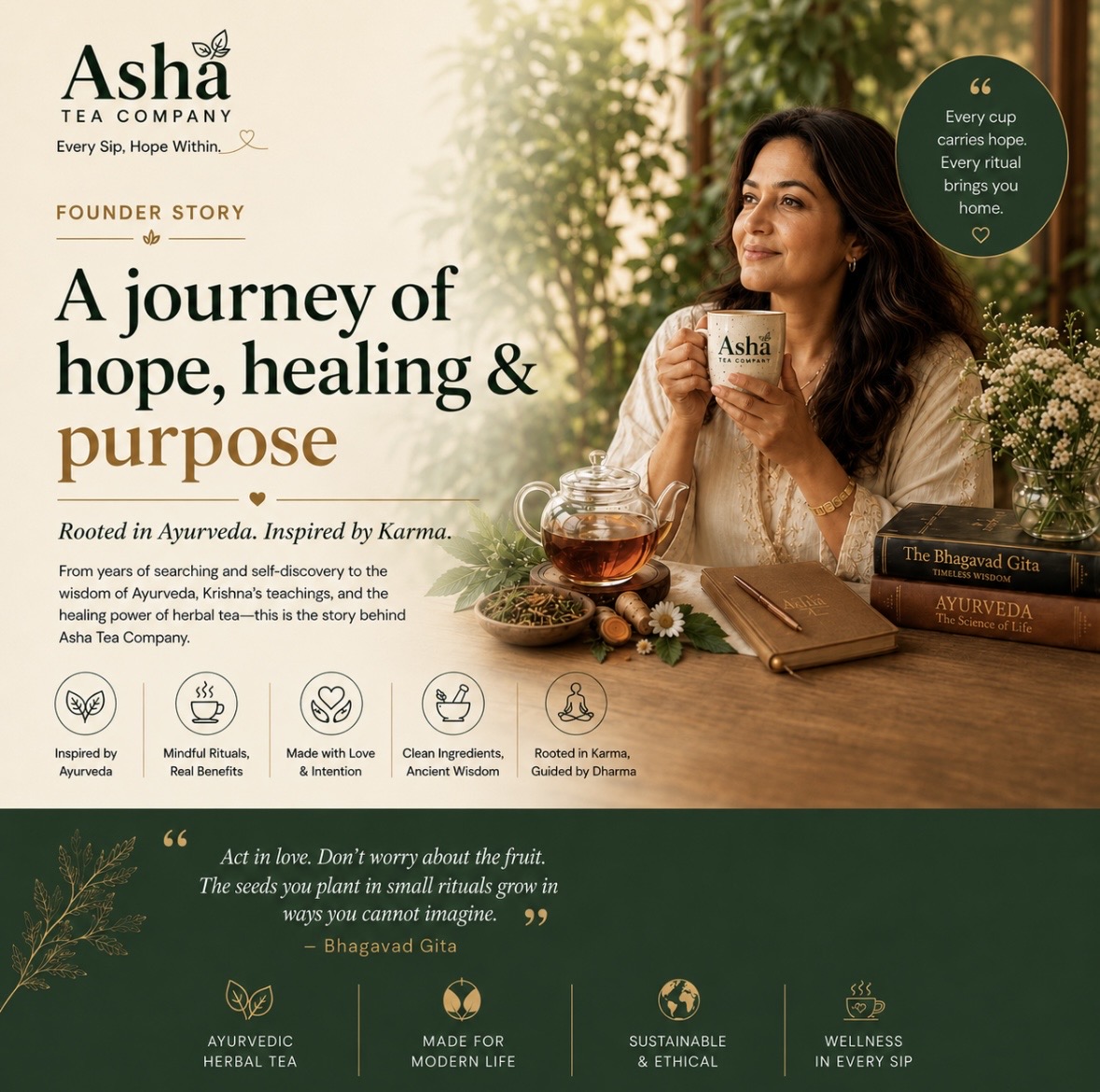
Act in love. Don’t worry about the fruit. The seeds you plant in these quiet morning
rituals grow in directions you cannot yet imagine.
With hope and warmth,
Asha
Founder, Asha Tea Company · Author, Fall in Love with Karma
please check out our product blend architecture for daily wellness and daily ritual at
website:www.ashateacompany.com
References
Free Radical Biology and Medicine – Oxidative Stress and Human Disease
European Journal of Preventive Cardiology – Tea Consumption and Cardiovascular Health
American Journal of Clinical Nutrition – Green Tea Catechins and Fat Oxidation
National Center for Complementary and Integrative Health (NCCIH)
World Health Organization (WHO) – Healthy Diet Guidelines