- Welcome to Asha Tea Company
- +91 9082650573
- ashateacompany01@gmail.com

There is a sound that every Indian knows in their bones.
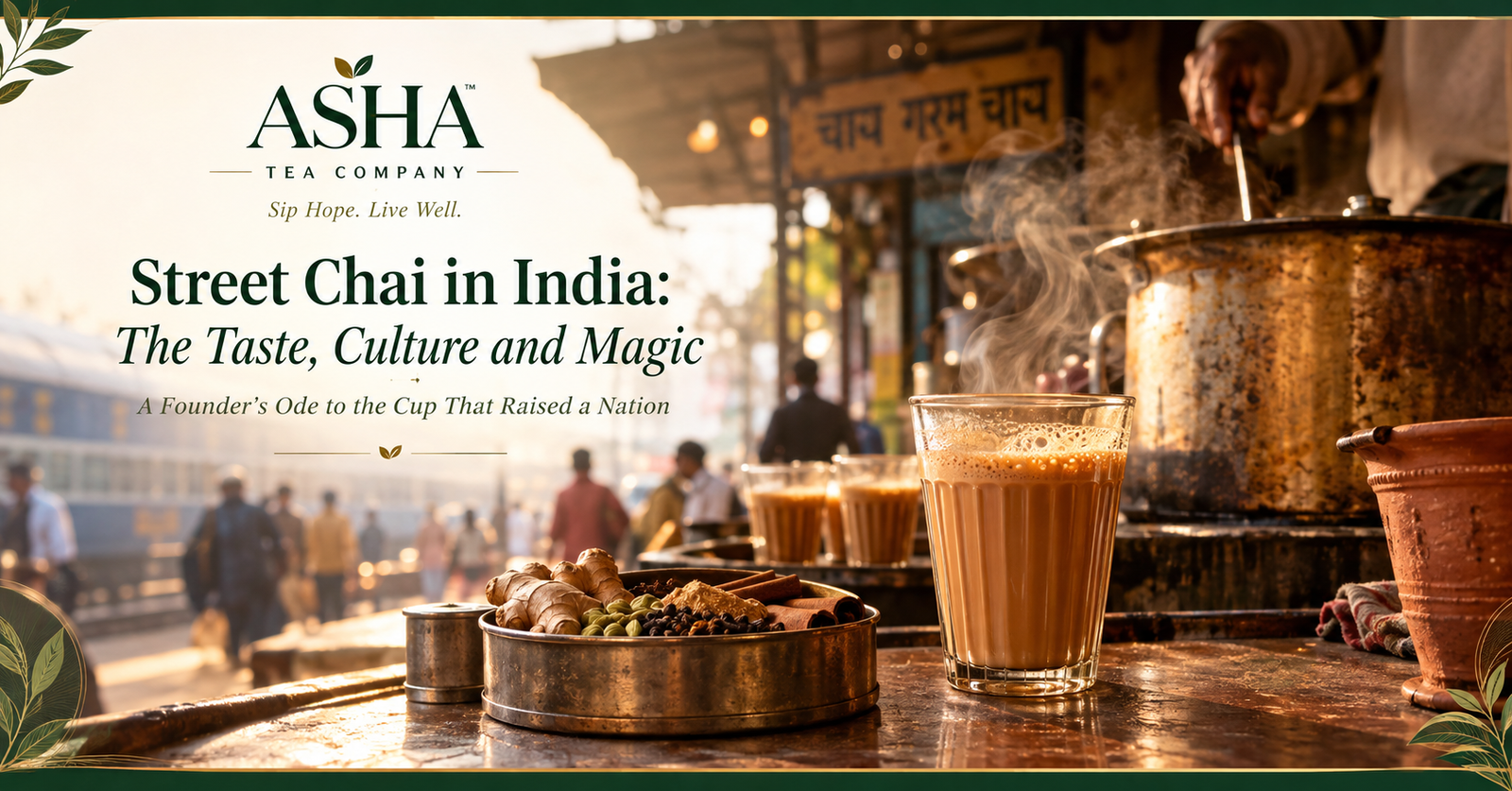
It is not a song, not quite a bell, but somewhere between the two — the clink of glass tumblers, the hiss of milk hitting a hot kadhai, the low murmur of “Chai, garam chai” cutting through a railway platform at 5 a.m.
If you have ever stood at a roadside stall wrapped in a shawl, holding a small glass that burns your fingertips just enough to remind you that you are alive, you already know why I started Asha Tea Company.
This is a love letter to that glass.
I grew up believing that chai was simply breakfast.
It took me years of travelling across this country, from the ghats of Varanasi to the hill roads of Himachal, to understand something.
Street chai in India is not a beverage. It is a form of memory.
Every region brews it differently. Kashmiri kahwa comes scented with saffron and almonds in the north. Mumbai’s local train stations serve sharp, ginger-heavy cutting chai. Hyderabad offers thick, almost dessert-like Irani chai with Osmania biscuits.
Yet somehow, no matter where you stand, that first sip carries the same message:
“You are home now, sit for a while.”
Watch a chaiwala for five minutes and you will see choreography, not chore.
The tea leaves go in first, then water. Next comes a fistful of spices, crushed just moments earlier so their oils have nowhere to hide.
Milk follows.
The chaiwala lets the whole pot rise, fall, and rise again. It becomes a small daily ceremony of patience that most of us have forgotten how to practice ourselves.
There is no recipe card taped to the cart.
The knowledge lives in the wrist. It passes down from a father, an uncle, a decade of mornings.
This is Indian chai culture at its most honest: unbranded, unhurried, and utterly unwilling to be rushed by modern life.
What strikes me every time is how democratic the stall is.
A software engineer and a rickshaw driver stand shoulder to shoulder at the same counter. Both wait for the same five-rupee glass. Both become equally silenced by the first scalding mouthful.
Few things in this country manage that kind of quiet equality.
Chai does it before nine in the morning, every single day, without anyone noticing the miracle.
Long before “adaptogenic” became a wellness buzzword, our grandmothers were already practicing it through the kitchen window.
The masala in masala chai — ginger for digestion, cardamom for calm, cloves for circulation, black pepper for immunity, cinnamon for warmth — is not a random spice blend.
It is a small piece of Ayurveda smuggled into daily life, one glass at a time.
Ayurvedic tradition has always treated the kitchen as the first pharmacy. Street chai is perhaps its most widely practiced remedy, even among people who have never opened a Charaka Samhita or heard the word dosha.
This is exactly the inheritance I wanted to protect when I built our own Kadak Chai and Tea Masala blends at Asha Tea Company.
Our Tea Masala carries that same idea into another everyday ritual — one spoon, a hundred ways to make chai your own.
We did not invent this wisdom. We simply refused to let it disappear under teabags full of dust and flavouring.
Every batch we create follows the way a chaiwala measures with his palm — by feel, by tradition, and by respect for what the spice is actually meant to do for the body, not just the tongue.
Scent is the most honest sense we have. It skips logic and goes straight to feeling.
This is why the smell of ginger and cardamom simmering on a stove can dissolve twenty years.
Suddenly, you are back in a grandmother’s kitchen, a hostel room, or a monsoon evening spent watching rain from a tin-roofed stall.
Street chai carries this emotional shortcut better than almost anything else in Indian life.
It is stitched into our festivals, our funerals, our farewells at railway stations, and our late-night confessions between friends.
We don’t schedule chai.
Chai arrives, uninvited and exactly on time, whenever the heart needs steadying.
When people ask what makes Asha Tea Company different from the wellness tea brands lining supermarket shelves, my answer is simple. My journey with tea, wellness and tradition shaped that answer.
We were never trying to modernise chai.
We were trying to honour it properly. That means using ingredients that are traceable and spices that are whole rather than powdered from unknown sources.
It also means following a philosophy rooted in nishkama karma — the Bhagavad Gita’s idea of action offered without attachment to reward.
Every blend we craft carries that same quiet devotion.
Our range includes warming Kadak Chai, Tea Masala, Digestive Fiber, and Calm & Sleep tea for the nights the day refuses to let go of you.
A roadside chaiwala brings that devotion to his kadhai each morning. We try to carry the same spirit into every blend.
We are not asking you to abandon the memory of street chai.
Instead, we are asking you to trust that the same integrity and the same unhurried respect for spice and ritual can live inside your own kitchen.
Brew it in a mug instead of a kulhad. The intention remains identical:
Comfort first, wellness always, no shortcuts taken.
I wrote once, in Fall in Love with Karma, that the smallest daily rituals are where we practice the biggest truths of our lives without realising it.
Chai is one of those rituals disguised as habit.
It teaches patience while the milk rises.
It teaches generosity. No chaiwala has ever poured a smaller glass for a stranger than for a regular.
Most of all, it teaches presence. You cannot rush a drink that will burn your tongue if you try.
This, to me, is the real magic of street chai in India.
The flavour alone is unforgettable. But the deeper magic lies in the philosophy hiding underneath it.
That philosophy waits patiently for anyone willing to slow down enough to taste it.
Travel far enough across India and you realise chai is less a single drink and more a shared language spoken in different dialects.
In Kolkata, tea often arrives in a small terracotta bhaar. The earthy clay lends its own quiet sweetness to the brew.
Afterward, people smash the empty cup on the ground. To me, it always felt like a tiny ceremony of letting go.
In Gujarat, chai leans stronger and spicier, built to survive the heat of an afternoon.
In the Northeast, the tea gardens of Assam produce the very leaves that fuel much of the country’s kadak cup.
The tea tastes malty and bold enough to need almost no sugar at all.
Rajasthan’s desert chai is boiled longer and thicker. It feels almost defiant against the dry wind.
None of these versions is the “correct” one.
Each is a regional signature.
Indian chai culture never came from a committee. It simply grew, city by city, kitchen by kitchen.
This is part of why I resist the idea that wellness tea has to look foreign to feel legitimate.
Long before glass jars and minimalist labels became fashionable, this country had already built an extraordinarily sophisticated tea culture of its own.
It balanced flavour, digestion, and comfort without needing a marketing department to explain it.
My job at Asha Tea Company has simply been to listen to that older wisdom and package it with the same honesty it deserves.
Ask anyone who has lost a family member in India, and they will tell you:
Chai appears before words do.
Neighbours arrive not with speeches but with a tray of tea. Sometimes, the kindest thing you can hand a grieving person is something warm to hold.
The same cup shows up at weddings and Diwali mornings thick with the smell of frying sweets.
It appears after exam results and during reunions of school friends who haven’t spoken in a decade.
Few beverages anywhere in the world carry such a wide emotional range.
Celebration and mourning, boredom and urgency, romance and heartbreak — all find their way into the same small glass.
That range is exactly what I try to protect every time we test a new blend before it earns the Asha Tea Company name.
So here is my invitation to you.
The next time life feels loud, do what this country has done for centuries.
Put the water on.
Crush the spices fresh.
Let the milk rise once, twice, three times.
Then pour yourself a small glass of something honest.
If you would like to start that ritual with a blend made the way a chaiwala would approve of, we would be glad to have you at our table.
Our blends carry whole ingredients, Ayurvedic intention, and a founder’s stubborn love for tradition.
Explore our Kadak Chai, Tea Masala, and full range of Ayurvedic wellness blends at www.ashateacompany.com.
Let a little bit of street-side India find its way into your morning.
Hope of Happiness starts with a single sip.