- Welcome to Asha Tea Company
- +91 9082650573
- ashateacompany01@gmail.com

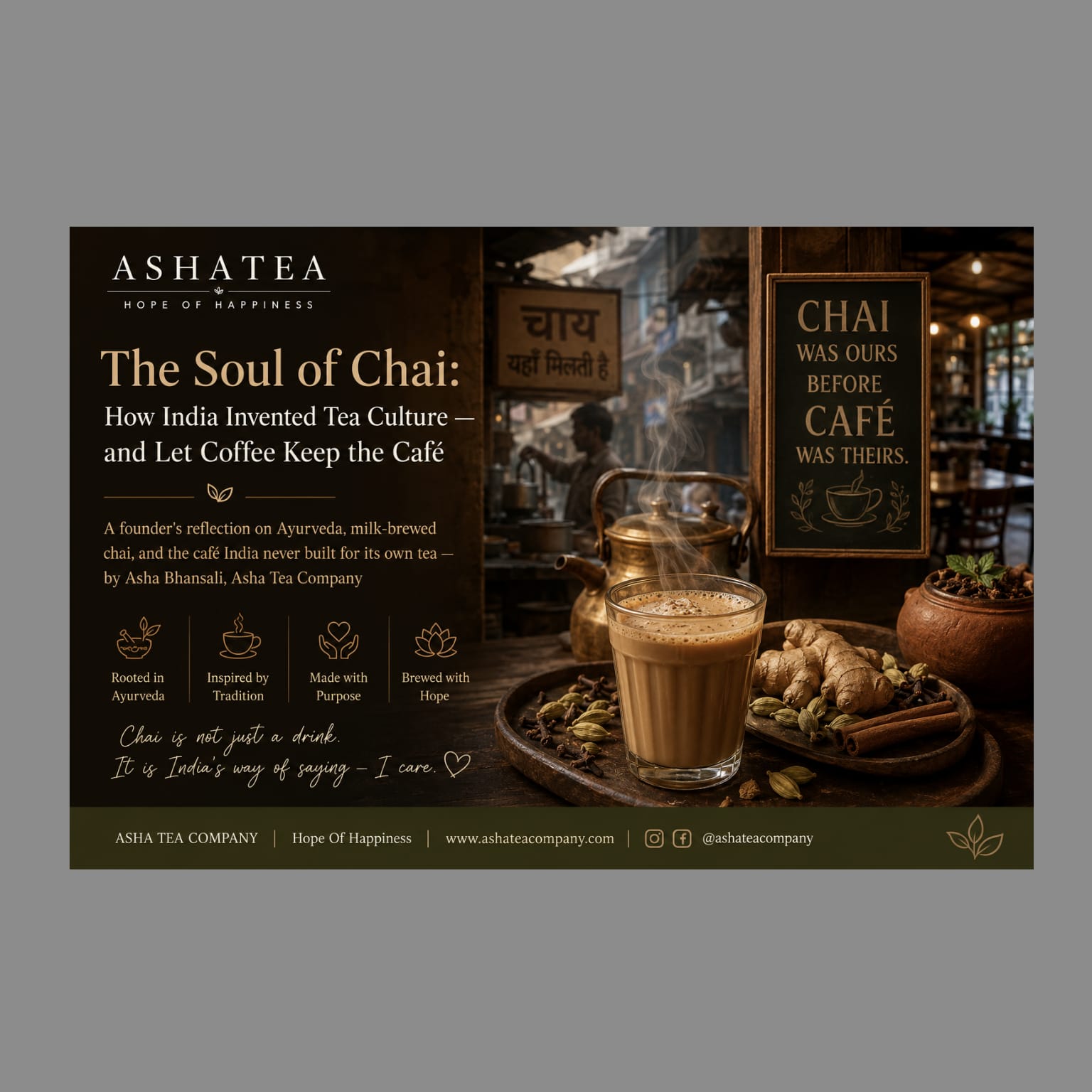
There is a smell that fills every Indian home. It rises before the household wakes: cardamom cracked between
fingers, ginger bruised on a board, milk beginning to climb the sides of a pan. Somewhere in that steam is a
memory of a grandmother, a monsoon afternoon, a first heartbreak talked through over a shared cup. Long
before “wellness” became a word on a label, India had already turned tea into medicine, ritual, and love. We
just called it chai.
I am Asha Bhansali, founder of Asha Tea Company, and this is the story of how my country gave the world
one of its most soulful drinking traditions — and then, somewhere along the way, handed the “café” over to
someone else.
India did not simply drink tea. India reinvented it. Somewhere in the kitchens of Rajasthan, Gujarat, and the
Punjab, someone decided that tea leaves alone were not enough — that they needed cardamom for warmth,
ginger for digestion, cloves for circulation, cinnamon for comfort. This was not decoration. This was
Ayurveda, quietly folding itself into a teacup. Milk was added not for indulgence but for balance, softening the
sharp edges of caffeine the way Ayurvedic wisdom has always sought balance between heat and cool,
stimulation and calm.
That drink became masala chai — kadak, strong, boiled patiently until milk, spice, and leaf were no longer
separate things but one amber-colored philosophy. It did not live behind glass counters. It lived on street
corners in clay kulhads, in office break rooms, in the hands of a mother waking her children for school. Chai
was never a product in India. It was a relationship.
For centuries, tea culture in India was not something you visited. It was something you belonged to.
And then the word “café” arrived — and quietly, without anyone quite noticing, it stopped meaning teaCoffee chains understood something tea never fought for: that people don’t just want a beverage, they want a
place. Coffee built armchairs, WiFi, playlists, loyalty cards, and a reason to linger. It gave itself a “third place”
between home and work. Tea, meanwhile, stayed loyal to the roadside stall — beautiful, honest, but never
invited inside the glass doors of modern café culture.
So an entire generation of young India grew up believing coffee was the drink of ambition, of meetings, of
“let’s catch up” — while chai was reduced to something you had standing up, in five minutes, before rushing
to catch a train. The irony is almost unbearable: the drink with centuries of ritual, medicine, and togetherness
woven into it never got a seat at its own table.
Tea did not lose because it was lesser. Tea lost because no one built it a home worth walking into.
I think about this often — how something so central to who we are as Indians was allowed to become
background noise while a borrowed bean became the face of modern café culture in our own cities. It stayed
with me the way an old family recipe stays with you long after the person who taught it to you is gone.
Asha means hope in Sanskrit. I did not choose that name by accident. Every blend we make — our Kadak
Chai, our Kashmiri Kahwa, our Calm & Sleep infusion — carries a small act of hope: that chai does not have
to apologize for its own greatness. That a drink rooted in Ayurveda and karma, in the wisdom of slowing
down, deserves the same dignity, the same design, the same devotion as anything served in a coffee cup.
Bringing Tea Back to the Café Table
This is why Asha Tea Company exists. Not to compete with coffee, but to finally give Indian tea culture the
space it always deserved — the packaging, the philosophy, the care that turns a cup into an experience rather
than a habit rushed through on the way out the door.
Every blend we craft honors what our grandmothers already knew: that tea can heal, calm, energize, and
comfort, depending on what the body and the day are asking for. We simply give that ancient wisdom a
modern home — one rooted in Ayurvedic wellness, in the Bhagavad Gita’s quiet teaching that small,
consistent acts of care are their own form of karma.
Tea does not need to become coffee to earn its place in a café. It only needed someone to believe it was worth
building one for.
If you have ever felt that ache — of loving chai your whole life while watching coffee take the spotlight — I
want you to know you were right to feel it. Our tea culture was never small. It was simply waiting for its own
café.
Come taste what centuries of Ayurvedic wisdom and a little hope can brew. Also read my blog: my journey-Asha Tea Company
Men’s Fashion India, History Of Tea, Asha Means Hope: the quiet story between every cup of Asha Tea,
Visit us at www.ashateacompany.com
Follow our journey @ashateacompany
Asha Tea Company — Hope Of Happiness
1. On “third place” café culture (in “When ‘Café’ Became a Coffee Word” section)
Anchor text: “third place”
Link: https://www.pps.org/article/roldenburg
(Project for Public Spaces — explains sociologist Ray Oldenburg’s original concept)
2. On Ayurveda (in “A Culture Brewed in Spice and Story” section)
Anchor text: “Ayurveda” or “Ayurvedic wisdom”
Link: https://www.nccih.nih.gov/health/ayurvedic-medicine-in-depth
(U.S. National Institutes of Health — authoritative, government-backed source, strong for E-E-A-T/SEO trust signals)
3. On karma / Bhagavad Gita (in “Bringing Tea Back to the Café Table” section)
Anchor text: “karma” or “the Bhagavad Gita’s quiet teaching”
Link: https://www.thecontemplativelife.org/blog/bhagavad-gita-karma-yoga
(Reputable explainer on karma yoga in the Gita — accessible, non-commercial, credible)
4. On tea’s role in Indian daily life (in the opening paragraph, around “clay kulhads” or street-side chai)
Anchor text: “chai culture” or “tea traditions”
Link: https://en.wikipedia.org/wiki/Masala_chai