- Welcome to Asha Tea Company
- +91 9082650573
- ashateacompany01@gmail.com

From the moment we are born, we begin to feel.
Before we have words for it, before we understand why, we feel. A mother’s warmth. The startle of cold air. The comfort of being held. Long before language arrives to name our world, feeling is already teaching us how to live in it.
And as we grow, our emotions grow with us. They do not stay still. They change, adapt, bend around the shape of our days — softened by joy, sharpened by loss, made wiser by time. Every experience leaves something behind. Not just a fact we remember, but a feeling we carry.
It is never just information. Memory is a bridge — one that stretches between who we were and who we are becoming, between the person we felt ourselves to be then, and the person quietly forming now. We do not cross this bridge once. We cross it every day, often without noticing, carried by the smallest, most ordinary things.
A cup of tea is one of those things.
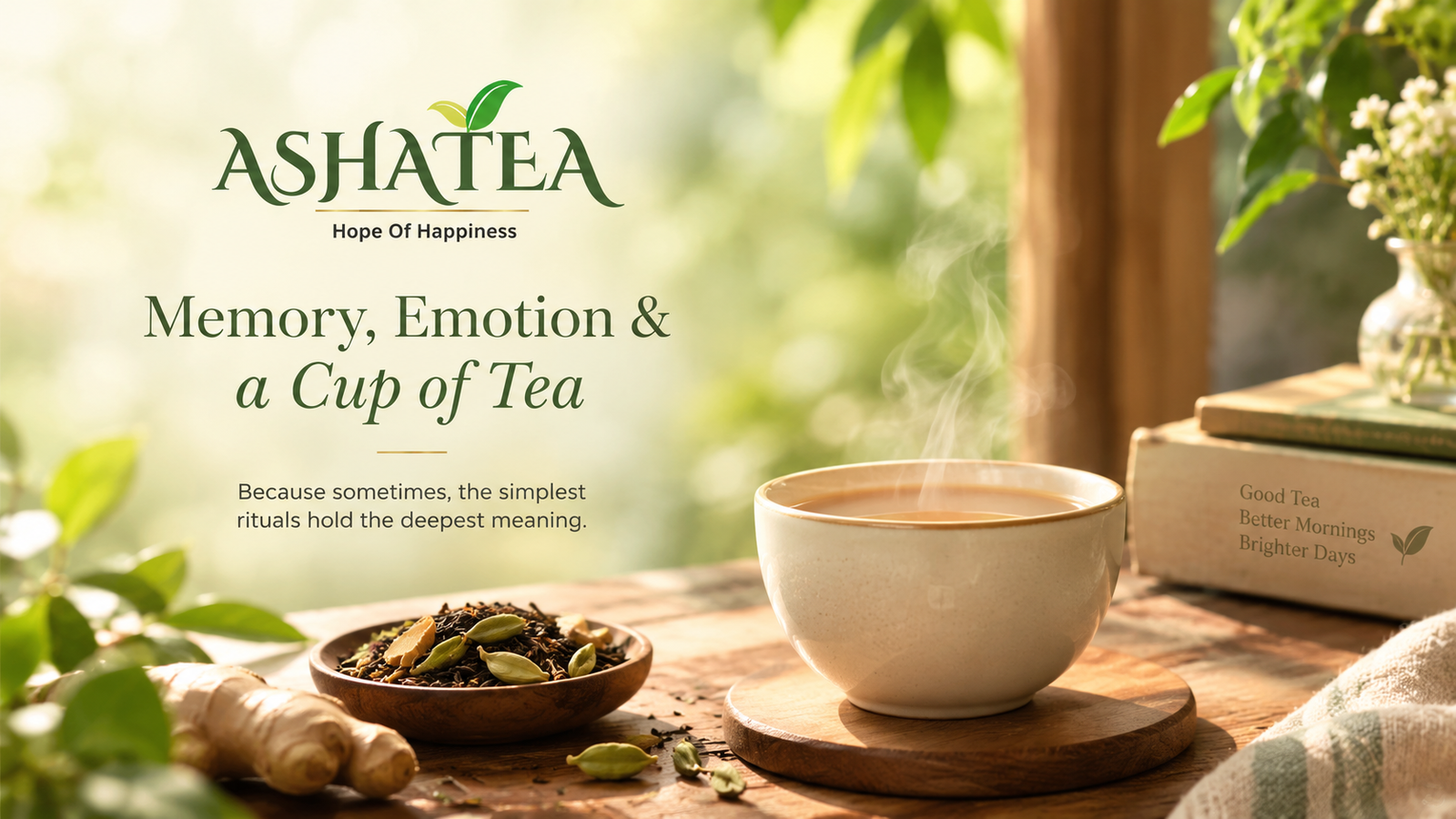
There is a particular kind of remembering that lives in warmth. The way steam rises and curls before disappearing. The scent of cardamom or ginger reaching you before the first sip does. The exact temperature of a cup held between both palms on a cold morning.
These are small sensations, but they are old ones too — echoes of another morning, another kitchen, another hand that once poured tea for you before you learned to pour it for yourself.
We don’t choose these memories. They arrive on their own, summoned by scent and warmth, arriving fully formed the way only feeling can. This is what tea has always done, quietly, in homes across generations — it holds space for us to feel our way back, even while standing fully in the present.
At Asha, we think of this often.
Our name means hope, and hope is not something that exists only in the future. Hope also lives in return — in the comfort of a familiar taste, a familiar warmth, a familiar pause in an otherwise hurried day.
When you hold a cup of tea, you are not escaping your feelings. You are meeting them. Softly. Presently. Fully.
This is the heart of what we call nishkama karma — action offered without attachment to outcome, presence without demand for anything in return.
Making tea, pouring it, sitting with it — these are small acts, but they ask nothing of us except to be there for the doing of them. No urgency. No destination. Just the ritual itself, and whatever it brings up in us.
Because that is what ritual quietly offers: it does not erase what we feel. It holds it. It steadies it. It gives our emotions a place to land, a few minutes carved out of the day where we are allowed to simply be — with our memories, our feelings, ourselves.
This is the bridge tea builds, cup by cup, morning by morning. Not one that carries us away from our lives, but one that carries us more gently through them.
So the next time you sit with a cup of tea, notice what rises with the steam. Notice which memory finds you. Let it.
That, too, is part of the ritual — remembering how to feel, present tense, one sip at a time.
This is the hope we brew into every cup — not to escape what we feel, but to meet it, softly, presently, fully.
Sip slowly. Remember deeply. Live presently.
Discover the Asha Tea ritual and make space for a little more hope in your everyday moments.
Sip Hope. Live Well.