- Welcome to Asha Tea Company
- +91 9082650573
- ashateacompany01@gmail.com

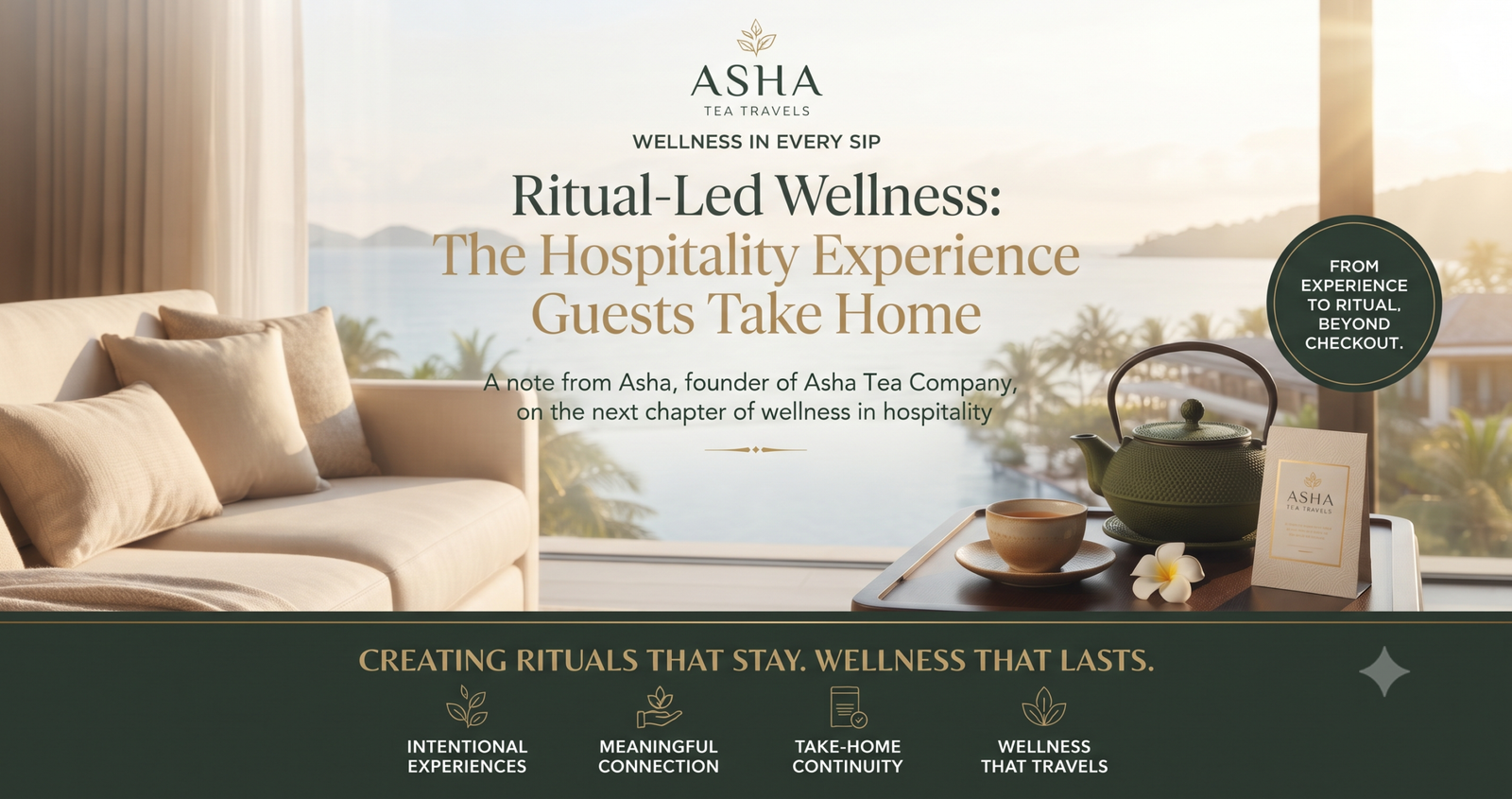
A note from Asha, founder of Asha Tea Company, on the next chapter of wellness in hospitality
Hospitality has become very good at creating moments of wellness.
A calming treatment. A beautifully designed spa. A restorative night’s sleep. A cup of tea waiting in the room. A quiet space to pause.
But there is a question I believe the next generation of wellness hospitality needs to ask:
Does this touchpoint end when the guest leaves the property, or does it leave with them?
That question is at the heart of Asha Tea Travels.
We believe the future of hospitality wellness is not simply about offering more wellness amenities. It is about creating rituals guests can experience, remember, repeat, and take home.
That is where tea becomes particularly powerful.
Wellness during a stay is often about how a guest feels in that moment.
They feel calmer after a treatment. They sleep better after a restorative evening. They slow down over breakfast. They take ten quiet minutes with a cup of tea instead of reaching immediately for their phone.
Those moments matter.
But a meaningful wellness experience can do something more.
It can introduce a guest to a simple ritual they want to continue when they return home.
That is the difference between wellness as an experience and wellness as a practice.
A ritual does not need to be complicated. It can be as simple as preparing a cup of tea at the same time each evening, creating a few minutes of quiet before bed, or beginning the morning with a mindful pause.
The value is not only in the cup.
It is in the habit, the pause, and the repetition.
Hotels and wellness properties invest enormous effort in creating an experience guests remember.
But what if the experience could also become something they continue?
Imagine a guest discovering a particular tea ritual during a stay.
They experience it in their room.
They learn how to prepare it.
They understand when to enjoy it.
They associate it with the feeling of slowing down.
And when they return home, they can continue that same ritual.
The property is no longer simply remembered for providing wellness.
It has helped introduce a wellness practice into the guest’s life.
That creates a different kind of relationship—one that can continue beyond checkout.
Tea sits at an unusual intersection of hospitality, sensory experience, and everyday wellness.
It is naturally ritualistic.
There is the sound of water being poured, the aroma rising from the cup, the warmth in the hands, and the few quiet minutes required to actually sit down and drink it.
Unlike many wellness experiences, tea does not require a treatment room or a specialist appointment.
It can happen in a guest room, at breakfast, after a spa treatment, beside a pool, or during an evening turndown.
And importantly, it can happen again at home.
That repeatability is what makes tea so interesting for hospitality.
The guest doesn’t have to leave the ritual behind.
Asha Tea Travels was created around this idea.
We work with hospitality and wellness properties to develop tea experiences that feel intentional and integrated into the guest journey.
The objective is not simply to place a tea pouch in a room.
It is to create a moment that feels considered.
A thoughtfully selected botanical tea paired with a simple ritual card can turn an ordinary in-room amenity into a meaningful pause in the guest’s day.
Tea can become part of the wellness journey before or after a treatment, creating a natural transition from activity to rest.
Guests can continue the same tea ritual after checkout through retail, gifting, or a take-home offering.
The experience that began at the property becomes something they can repeat at home.
A wellness ritual becomes more meaningful when the team understands the story behind it.
Staff can introduce the tea naturally and explain how the ritual fits into the guest experience without turning the conversation into a medical claim.
Longevity is an important part of the conversation happening across modern hospitality.
But we should be careful not to use the word simply because it sounds more sophisticated than wellness.
True long-term wellbeing is built through consistent behaviors, not marketing language.
A hotel does not need to promise that one cup of tea will change a guest’s future.
It can do something more credible:
Introduce a ritual worth repeating.
Over time, repeated rituals can become habits. Habits can become part of a person’s lifestyle. And that is where the conversation about longer-term wellbeing becomes meaningful.
For Asha Tea Travels, longevity is therefore not the headline promise.
The ritual comes first.
The next generation of hospitality wellness may not be about choosing between wellness and longevity.
It may be about creating experiences that connect the two naturally.
Wellness gives the guest something to feel today.
A ritual gives the guest something to repeat tomorrow.
And when that ritual travels home, the relationship with the property does not necessarily end at checkout.
That is the opportunity for hospitality brands.
Not simply to provide another amenity.
Not to put “wellness” or “longevity” on a menu because the words are trending.
But to create experiences that are simple enough to use, meaningful enough to remember, and natural enough to become part of everyday life.
Does this touchpoint end when the guest leaves the property, or does it leave with them?
At Asha Tea Travels, we believe the most powerful wellness experiences are the ones that do both.
They make the guest feel cared for today—and give them a ritual they can carry forward.
Asha Tea Travels is the hospitality partnership arm of Asha Tea Company, creating thoughtful tea and wellness rituals for hotels, resorts, spas, and other hospitality environments.
Our focus is simple: turning tea from an amenity into an experience—and from an experience into a ritual that travels.
Interested in bringing a thoughtful tea and wellness ritual to your hotel, resort, spa, or hospitality property?
Discover Asha Tea Travels and explore how tea can become more than an amenity—it can become part of the guest experience.